
- Why a2 Milk®
- Discover Lactose Free
a2 Milk®
Lactose Free
a2 Milk® Lactose Free, naturally A1 protein free milk that is also lactose free. Creamy, great tasting, rich in nutrients, and easy to digest*. Available in Full Cream and Light at selected Coles, Woolworths and independent supermarkets.
*a2 Milk® Lactose Free may be easy to digest compared to ordinary milk for some people who are sensitive to lactose, when consumed as part of a healthy, varied diet.
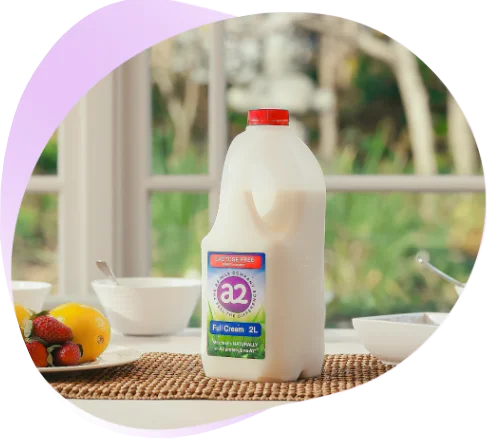
Why choose a2 Milk® Lactose Free?
a2 Milk® Lactose Free comes from cows specially selected to naturally produce milk with only A2-type beta-casein protein. With a rich and creamy taste and no lactose or A1 protein, it’s easy to see why so many people choose a2 Milk® Lactose Free.

No lactose and naturally A1 protein free
a2 Milk® with naturally no A1 protein, and no lactose.

Rich & creamy real dairy
The great taste, nutritional benefits, and creamy texture of real dairy milk.

Easy to digest*
*a2 Milk® Lactose Free may be easy to digest compared to ordinary milk for some people who are sensitive to lactose, when consumed as part of a healthy, varied diet.

What is lactose free milk?
Lactose free milk is a dairy milk option for people who have difficulty digesting ‘lactose’, a natural sugar found in milk. It’s easy to digest because the lactose has been broken down by the enzyme ‘lactase’. This means people with lactose intolerance can still enjoy the creamy taste and nutritional benefits of cow’s milk.
How is lactose free milk made?
Lactose free milk is made by adding a natural enzyme, called ‘lactase’, to regular cow’s milk. This enzyme breaks down the lactose into two simpler sugars (glucose and galactose) making it easier for the body to digest. This process retains the taste, nutritional benefits, and creamy texture of dairy milk.
How is lactose free milk different from regular dairy milk?
The main difference between lactose free milk and regular milk is how it is digested. Lactose free milk contains the same protein, calcium, and essential vitamins, such as A, D and B12, as regular milk. The only change is that the lactose has already been broken down in lactose free milk. This can help people with lactose intolerance avoid symptoms like bloating, abdominal pain and discomfort that they may experience when consuming regular milk.
What’s the benefit of this?
The a2 Milk® Lactose Free range allows people who are lactose intolerant or following a low-lactose diet to enjoy real dairy again. Because it is still cow’s milk, a2 Milk® Lactose Free retains all the nutrients found in regular milk, including complete protein, calcium, vitamins and minerals.

Is lactose free milk better for your gut?
Lactose free milk may suit your gut better if you have difficulty digesting lactose. The gut plays a vital role in breaking down food and absorbing nutrients for energy, recovery and overall health. When lactose isn’t properly digested, it can ferment in the gut, leading to symptoms such as bloating, stomach pain, gas and diarrhoea.
For people with lactose intolerance, switching to lactose free milk may help reduce digestive discomfort. This is because the lactose has already been broken down, making it easier on the digestive system and less likely to trigger gastrointestinal symptoms than regular milk.
a2 Milk® Lactose Free is easy to digest without compromising nutrition. It delivers the same high-quality dairy protein, calcium and essential vitamins found in regular milk, but without the lactose or A1 protein that can cause discomfort for some people.
Whether you prefer a creamier texture or a lower-fat option, a2 Milk® Lactose Free comes in Full Cream and Light to suit your taste and dietary needs, offering the benefits of real dairy milk while being easier on digestion.
Try our lactose free range
Love full-bodied, creamy milk? Try a2 Milk® Lactose Free Full Cream. Prefer something lighter? We also offer a2 Milk® Lactose Free Light.

a2 Milk® Lactose Free Full Cream

a2 Milk® Lactose Free Light
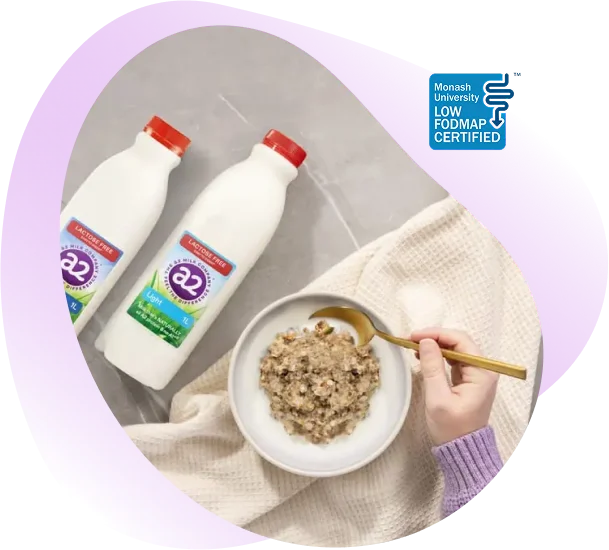
a2 Milk® Lactose Free is Monash University Low FODMAP Certified
a2 Milk® Lactose Free is Monash University Low FODMAP Certified, making it suitable for people following a low FODMAP diet. This certification means the product has been tested and meets Monash University’s criteria for foods that are low in specific carbohydrates known to trigger digestive symptoms in some individuals.
What does Low FODMAP mean?
FODMAP stands for Fermentable Oligosaccharides, Disaccharides, Monosaccharides and Polyols. These are a group of short-chain carbohydrates that can be poorly absorbed in the gut. In some people with sensitive digestion, including those with irritable bowel syndrome (IBS), FODMAPs can contribute to symptoms such as bloating, abdominal pain, gas and diarrhoea.
Why is lactose free milk Low FODMAP?
Lactose is a FODMAP carbohydrate, which is why regular milk is not considered low FODMAP. a2 Milk® Lactose Free contains no lactose or other FODMAP carbohydrates, which is why it is Monash University Low FODMAP Certified.
Understanding the certification
Monash University Low FODMAP Certified trademarks are used under licence in Australia by The a2 Milk Company (Australia) Pty Ltd. One serving of a2 Milk® Lactose Free can assist with following the Monash University Low FODMAP diet™. A strict Low FODMAP diet should not be commenced without supervision from a healthcare professional.
Important to know
Monash University Low FODMAP certification applies only to the a2 Milk® Lactose Free range, due to the absence of lactose and all other FODMAP carbohydrates. All other a2 Milk® products contain lactose and, for this reason, are not Low FODMAP.
FAQs
Does lactose free milk contain A1 protein?
Lactose free milk and A1 protein free milk cater to different dietary needs and sensitivities.
Lactose free milk is specifically designed to help individuals who can't completely digest lactose, a carbohydrate (sugar) found in regular cow's milk. By adding lactase enzyme to cow's milk, the lactose is broken down into smaller sugars that most lactose intolerant people can drink without experiencing symptoms, whilst still retaining the same goodness and nutritional benefit of dairy milk.
Removing the lactose doesn't change the type of proteins in the milk though, and most lactose free milk still contains both A1 and A2-type beta-casein proteins. This means that people who have a sensitivity to A1 protein may still experience gastrointestinal symptoms from drinking lactose free milk.
Hence, we introduced the a2 Milk® Lactose Free range, that is naturally A1 protein free and also lactose free.
How is a2 Milk® different from regular cow's milk brands?
What makes a2 Milk® different from ordinary fresh cow's milk is the absence of the A1 protein. Most ordinary cow's milk brands today contain a combination of two main types of beta-casein protein, namely A1 and A2-type. a2 Milk® is special because it is an exception to this. a2 Milk® naturally contains no A1 protein, so it may be easier on digestion than ordinary milk for some milk-intolerant individuals. The a2 Milk Company uses comprehensive herd selection to choose cows which naturally produce milk free from the A1 protein.
Is lactose free milk dairy free?
No, lactose free milk is still a dairy product. While lactose has been broken down, it is still cow’s milk and contains dairy proteins.
What does lactose free milk taste like?
Lactose free milk tastes very similar to regular milk. Some people may notice a slightly sweeter taste, due to lactose being broken down into simpler sugars, but the texture remains smooth and creamy. Rest assured, no sugar or sucrose is added to the a2 Milk® Lactose Free range.
Is lactose intolerance the same as dairy intolerance?
No, lactose intolerance and dairy intolerance are different. Lactose intolerance occurs when the body doesn’t produce enough lactase to digest lactose in the diet, causing bloating, gas, abdominal pain and diarrhoea. While uncomfortable, these symptoms are not usually dangerous.
Dairy intolerance is a broader term that can include sensitivities to casein, whey or naturally occurring amines (particularly in cheese). Symptoms and tolerance levels will vary between individuals.
A dairy allergy (cow’s milk protein allergy) is a serious medical condition which requires complete avoidance of all dairy products.
Is a2 Milk® still suitable for people who think they’re lactose intolerant?
Although it is commonly assumed that gastrointestinal symptoms experienced after consuming ordinary milk are due to lactose intolerance, lactose might not be the cause of some people’s digestive discomfort. Some people who have difficulty drinking milk report fewer digestive symptoms after drinking a2 Milk® compared to regular milk. Individual tolerance varies, which is why a2 Milk® offers both regular and lactose free options.
I’m lactose intolerant but already drink a2 Milk®. Should I switch?
If you can tolerate a2 Milk® without discomfort, there may be no need to switch. Many people with lactose intolerance can tolerate around 12g of lactose per day (about one cup of milk), especially when intake is spread out across the day.
If you start experiencing digestive discomfort, or would like to consume larger volumes of milk, you may wish to try a2 Milk® Lactose Free. If symptoms persist or worsen, we recommend consulting a healthcare professional.
How is a2 Milk® made?
The single most important factor in producing our delicious a2 Milk® is to find the right dairy cows. Our farmers exclusively select cows that naturally produce milk containing only the A2-type beta-casein protein and no A1 protein.
This is done by using a simple genetic test performed on a tissue sample taken from the cows and involves DNA analysis to identify cows that naturally produce milk with only A2-type beta-casein protein and no A1 protein.
Is a2 Milk® natural?
Yes, a2 Milk® is naturally occurring cow's milk; it's not a result of a technological process or genetic engineering. We simply select cows that naturally produce milk with only A2-type protein and no A1 protein.
What is being done to ensure the welfare of your animals?
a2 Milk® is enjoyed by many across the nation. The welfare of our animals has been a cornerstone of the a2 Milk® success story. Our commitment to high living standards for all animals involved in and impacted by the supply of a2 Milk® is underpinned by a respect for animal welfare, and belief in the positive impact that animal welfare standards can have on milk production and milk quality. Our vision is for a best-in-class animal welfare management system that exceeds Australian dairy industry standards. To help achieve this vision, we engage an independent expert organisation for auditing and certification of the animal welfare management practices on all our farms supplying A1 protein free milk across the nation. More information about our partner, Validus, can be found here.
Does a2 Milk® contain permeate?
a2 Milk® does not contain any permeate or any additives, which is why it tastes so refreshing, as real milk should taste.
Does a2 Milk® have the same calcium levels as regular milk?
Yes, a2 Milk® contains roughly the same amounts of calcium and other important minerals as other unfortified cow’s milks.
Does a2 Milk® help those with allergies?
Cow's milk allergy is a serious condition and is different from cow's milk intolerance. If you or your child is known to suffer from a cow's milk allergy, you should consult your doctor or paediatrician before consuming ANY milk variety, including a2 Milk®. All milk contains a variety of biological molecules known to affect the immune system. a2 Milk® contains all of the proteins that you would find in ordinary cow's milk except for the A1 beta-casein protein. Therefore, those people with allergies to the proteins in ordinary cow's milk will not be able to drink a2 Milk®. However, a2 Milk® may help to reduce digestive discomfort in some people who have difficulty digesting ordinary cow's milk as opposed to having a milk allergy. There is a growing body of evidence that supports the unique benefits of milk containing only A2-type beta-casein protein like a2 Milk®.*
*a2 Milk® is naturally A1 protein free, so it may be easier on digestion than ordinary milk for some milk-intolerant individuals, when consumed as part of a healthy varied diet.
Is a2 Milk® a product of genetic engineering or modification (GE or GM)?
Absolutely not! a2 Milk® is obtained naturally from cows specially selected for their genetic makeup.
Is a2 Milk® produced in Australia?
Absolutely. All of our fresh a2 Milk® is produced from local cows and supports local Aussie farmers.
What is a protein?
Proteins are large biological molecules made up of long chains of amino acids.
What is beta-casein?
Beta-casein is a type of protein that makes up one third of the protein content in milk. It is a milk protein that is a source of essential amino acids, as well as peptides.
What is homogenised milk?
Homogenised milk has been treated to disperse the cream layer containing the milk fat throughout the milk. Homogenised milk generally has a longer shelf life than un-homogenised milk.
What is pasteurisation?
Pasteurisation is a method of heating milk for a short time to kill off bacteria which would otherwise cause the milk to spoil.
Where can I buy a2 Milk®?
a2 Milk® is widely available in supermarkets across Australia.
Where can I find out about the nutritional information for a2 Milk®?
You can find the nutritional information for each of our products here. The nutritional information can also be found on the back label of every a2 Milk® bottle or carton.
Where can I find out more about A2-type beta-casein protein?
You can learn more about our science and testing here at a2Research.org.
Can I have cow's milk if I am lactose intolerant?
People with lactose intolerance often avoid cow's milk and other dairy products, however research has shown that lactose intolerant individuals can usually tolerate up to 12-15g of lactose per day, which is equivalent to 250ml cow's milk or one serve. The Australian Dietary Guidelines recommend that this amount of cow's milk may be well tolerated by lactose intolerant individuals when consumed with other foods and spread throughout the day. Each person with lactose intolerance will have their own level of tolerance. For those wishing to consume a larger daily volume of cow's milk, this should be guided by tolerance, or you may like to use lactose free dairy products.
Can I have a2 Milk® if I am lactose intolerant?
For those who prefer to avoid lactose altogether, there is a2 Milk® Lactose Free, available in both Full Cream and Light options.
Is a2 Milk® suitable for older adults as lactase activity declines with ageing?
The decline of lactase levels with age is a common biological change that may affect the ability of some older adults to digest lactose. People with lactose intolerance often avoid cow's milk and other dairy products, however research has shown that lactose intolerant individuals can usually tolerate up to 12-15g of lactose per day, which is equivalent to 250mL cow's milk. The Australian Dietary Guidelines recommends that this amount of cow's milk may be well tolerated by lactose intolerant individuals when consumed with other foods and spread over the day. Each person with lactose intolerance will have their own level of tolerance. For those wishing to consume a larger daily volume of cow's milk, this should be guided by tolerance, or a lactase enzyme supplement may be taken to assist with a larger volume to be tolerated.
For those who prefer to avoid lactose altogether, there is a2 Milk® Lactose Free, available in both Full Cream and Light options.
Is a2 Milk® suitable for a low‑FODMAP approach?
Monash University Low FODMAP certification applies only to the a2 Milk® Lactose Free range, due to the absence of lactose and all other FODMAP carbohydrates.
All other a2 Milk® products contain lactose and, for this reason, are not Low FODMAP.
Do your farms use the Bovaer or Rumin8 supplement?
None of the farms that supply our a2 Milk® use the Bovaer or Rumin8 supplement.
Need more Help?

Get Expert Support
Our a2™ Careline is supported by Accredited Practising Dietitians ready to help answer your questions.